Overview
What is skin cancer?
Skin cancer occurs when abnormal changes develop within skin cells, causing them to grow and multiply uncontrollably. Instead of following the normal cycle of growth and replacement, damaged cells continue dividing and may eventually form a cancerous lesion or tumour.
Skin cancer is the most common form of cancer in the UK. Each year, there are around 156,000 cases of non-melanoma skin cancer and approximately 19,000 to 20,000 cases of melanoma diagnosed across the UK. Most cases are linked to cumulative exposure to ultraviolet (UV) radiation from sunlight or sunbeds. 1
Skin cancer can affect people of all ages and skin tones. Although it most commonly develops on areas exposed to sunlight, it can occur anywhere on the body, including areas that receive little or no sun exposure.
Many skin cancers are slow growing and highly treatable when detected early. However, some forms can grow deeper into the skin, spread to nearby lymph nodes or affect other parts of the body if left untreated.
How common is skin cancer?
Skin cancer is the most common form of cancer in the UK. The majority of cases are non-melanoma skin cancers, primarily basal cell carcinoma (BCC) and squamous cell carcinoma (SCC). Melanoma is less common but is generally considered more serious because it is more likely to spread if not diagnosed early.
What causes skin cancer?
The primary cause of skin cancer is exposure to ultraviolet (UV) radiation.
UV radiation damages the DNA within skin cells. Over time, repeated exposure can overwhelm the skin’s natural repair mechanisms, allowing abnormal cells to survive and multiply.
Sources of UV radiation include:
- Natural sunlight
- Sunbeds and tanning devices
Other factors that may increase risk include:
- Fair skin that burns easily
- Previous episodes of sunburn
- Increasing age
- A weakened immune system
- A personal or family history of skin cancer
- Having many moles or atypical moles
- Long-term occupational or recreational sun exposure
Who is at risk?
Anyone can develop skin cancer. However, the risk is higher in people who:
- Have fair skin, light eyes or light hair
- Burn easily in the sun
- Have a history of significant sun exposure
- Use sunbeds
- Have previously had skin cancer
- Have a weakened immune system
- Have a family history of skin cancer
People with darker skin tones can also develop skin cancer, although it is generally less common.
Where on the body does skin cancer usually appear?
Skin cancer most often develops on areas exposed to the sun, including the face, scalp, ears, neck, arms and hands. It can also occur on areas that receive little sun exposure, such as the palms, soles of the feet, nails and genital skin, particularly in melanoma.
Types of skin cancer
Basal Cell Carcinoma (BCC)
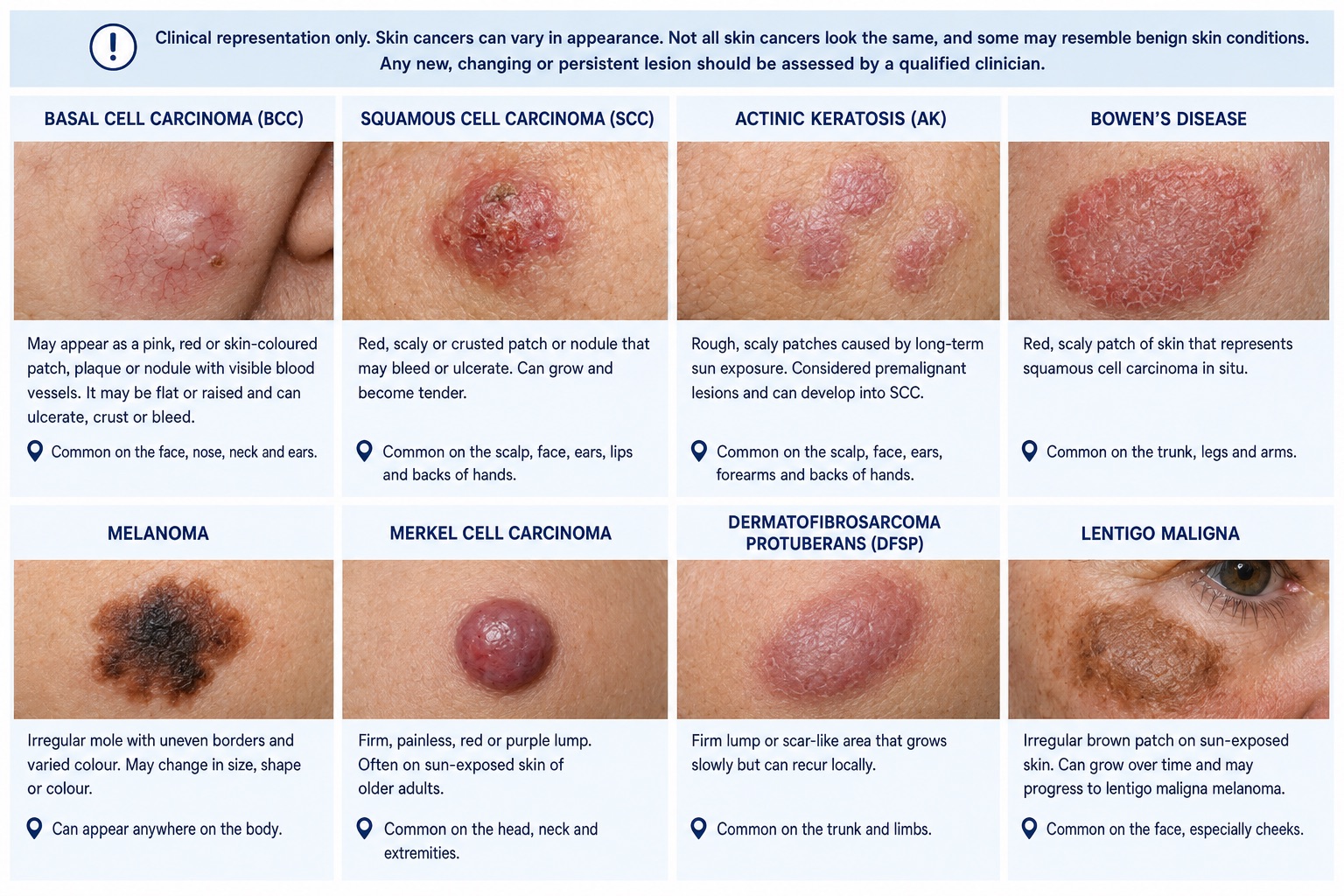
Basal cell carcinoma (BCC) is the most common type of skin cancer in the UK. It develops from basal cells within the lower part of the epidermis and usually grows slowly. BCC rarely spreads to other parts of the body, but it can damage surrounding skin and deeper tissues if left untreated.
Common locations: Nose, cheeks, eyelids and ears.
Common signs include:
- A pearly or shiny bump
- A pink or red patch
- A sore that does not heal
- Recurrent bleeding, crusting or scabbing
Squamous Cell Carcinoma (SCC)
Squamous cell carcinoma (SCC) is the second most common type of skin cancer in the UK. It develops from squamous cells within the outer layer of the skin and can grow deeper into surrounding tissues. In some cases, SCC can spread to nearby lymph nodes or other parts of the body.
Common locations: Scalp, ears, lips and the backs of the hands.
Common signs include:
- A rough or scaly patch
- A thickened or crusted lesion
- A rapidly growing lump
- An ulcer that does not heal
Melanoma
Melanoma develops from melanocytes, the pigment-producing cells that give skin its colour. Although less common than BCC and SCC, melanoma is considered the most serious form of skin cancer because it is more likely to spread to other parts of the body if not detected and treated early.
Common locations: Back, legs, arms or any site where a new or changing mole develops.
Common signs include:
- A new mole
- Changes in an existing mole
- Irregular shape or border
- Multiple colours within a lesion
- Progressive change over time
Other Rare Skin Cancers
Less common skin cancers include:
- Merkel cell carcinoma
- Sebaceous carcinoma
- Cutaneous lymphoma
- Kaposi’s sarcoma
- Dermatofibrosarcoma protuberans
These cancers are uncommon and usually require specialist assessment and treatment.
Related Precancerous and Early Skin Conditions
Bowen's Disease
Bowen’s disease is the earliest form of squamous cell carcinoma (SCC), where abnormal cells are confined to the outer layer of the skin. It commonly appears on the lower legs, forearms and trunk as a persistent red, scaly patch and is usually highly treatable.
Actinic Keratoses (Solar Keratoses)
Actinic keratoses are precancerous patches caused by long-term sun exposure, most commonly affecting the face, scalp, ears and backs of the hands. While most remain harmless, a small proportion can develop into squamous cell carcinoma over time and indicate significant cumulative UV damage.
Lentigo Maligna
Lentigo maligna is the earliest stage of melanoma, where abnormal pigment cells are confined to the outer layer of the skin. It most commonly develops on chronically sun-exposed areas such as the face and scalp in older adults and typically appears as a slowly enlarging, irregularly pigmented patch.
Symptoms and Causes
What are the symptoms of skin cancer?
Skin cancer does not always cause pain or discomfort. Possible signs include:
- A new spot, lump or growth on the skin
- A sore that does not heal
- A scaly, crusted or bleeding area
- A mole that changes in size, shape or colour
Changes may develop slowly over time and may not cause symptoms initially.
What skin changes should raise concern?
Seek assessment for skin changes such as:
- Rapid growth
- Irregular or poorly defined borders
- Changes in colour or multiple colours in one lesion
- Persistent itching, tenderness or bleeding
- A lesion that looks different from others on the body
What does melanoma look like?
Melanoma often appears as a new mole or a change in an existing mole. The ABCDE guide can help identify concerning features:
- Asymmetry
- Border irregularity
- Colour variation
- Diameter increasing
- Evolving in size, shape or colour
Diagnosis and Tests
How is skin cancer diagnosed?
Specialists combine clinical assessment, dermoscopy and, where needed, biopsy and laboratory testing to assess suspicious moles and skin lesions and determine whether further investigation is required.
Key diagnostic steps:
- Full skin examination: Assessment of the skin to identify new, changing or suspicious lesions.
- Dermoscopy: Magnified examination of moles and lesions to identify features that may require further investigation.
- Biopsy: A small tissue sample may be taken when a lesion requires laboratory testing.
- Histopathology: Laboratory examination of tissue samples to help confirm a diagnosis and guide treatment.
Skin cancer screening can help identify concerning changes early and provide clear guidance on monitoring, investigation or treatment where needed.
Are imaging tests ever needed?
Imaging such as ultrasound, CT, MRI or PET scans may occasionally be used when there is concern that a cancer has spread beyond the skin. This is generally reserved for selected cases of melanoma, advanced SCC or other high-risk skin cancers.
Management and Treatment
How is skin cancer treated?
Treatment depends on the type, location, size, and stage of the cancer, as well as the patient’s overall health and preferences.
Treatment options
- Surgery – Surgical removal is the most common treatment, involving excision of the cancer with a margin of healthy tissue under local anaesthetic. Larger or complex lesions may require a skin graft or reconstruction.
- Radiotherapy – High-energy rays target and destroy cancer cells. Radiotherapy is used when surgery is unsuitable, the cancer covers a wide area, or as adjuvant therapy to prevent recurrence.
- Immunotherapy – This stimulates the immune system to attack cancer cells. It includes topical creams like imiquimod for superficial lesions and checkpoint inhibitors for advanced melanoma or SCC.
- Photodynamic Therapy (PDT) – A light-sensitive drug is applied to the lesion and activated with a special light to destroy superficial cancer cells, suitable for early or thin lesions.
- Chemotherapy – Chemotherapy is mostly applied as a topical cream for superficial skin cancers. Rarely, intravenous chemotherapy may be used for aggressive or metastatic disease.
- Multimodal treatment – Advanced cases may require a combination of surgery, radiotherapy, and systemic therapies to achieve the best outcome.
Outlook/Prognosis
The outlook depends on the type of skin cancer and how early it is diagnosed.
- Basal cell carcinoma is usually highly treatable and rarely spreads.
- Bowen’s disease is highly treatable because it remains confined to the skin surface.
- Actinic keratoses are not cancerous but should be monitored because some can progress to SCC.
- Squamous cell carcinoma is often curable when treated early.
- Melanoma has excellent outcomes when detected early, but advanced disease can be more difficult to treat.
Can skin cancer come back after treatment?
Yes. People who have had skin cancer have a higher risk of recurrence or developing a new skin cancer, which is why follow-up and regular skin checks are important.
Prevention
Can skin cancer be prevented?
Not all skin cancers can be prevented, but the risk can be significantly reduced through good sun protection habits.
Helpful measures include:
- Avoiding sunburn
- Seeking shade during the strongest sunlight
- Wearing protective clothing, wide-brimmed hats and UV-protective sunglasses
- Using a broad-spectrum sunscreen with SPF 30 or higher and high UVA protection
- Reapplying sunscreen regularly
- Avoiding sunbeds and tanning devices
- Performing regular skin self-checks
How often should you check your skin?
Becoming familiar with your skin can help you recognise new or changing lesions more easily.
Any mole, patch or skin lesion that changes in size, shape, colour or texture, or fails to heal, should be assessed by a healthcare professional.