Overview
What are sebaceous cysts?
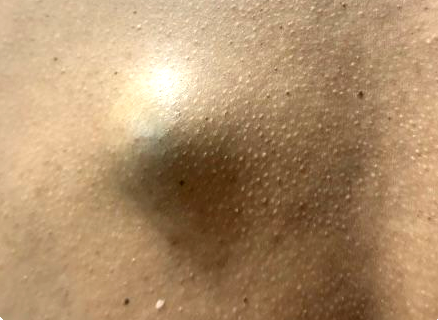
A sebaceous cyst is a slow-growing, non-cancerous lump beneath the skin. The term is commonly used to describe skin cysts, but most so-called “sebaceous cysts” are actually epidermoid cysts, which form from skin cells rather than sebaceous glands.
True sebaceous cysts arise from sebaceous (oil-producing) glands and are less common. In everyday medical practice, however, the terms are often used interchangeably. They are typically harmless and slow growing. Most do not require treatment unless they become painful, infected or bothersome.
Size and appearance
Sebaceous and epidermoid cysts typically:
- Measure between a few millimetres and several centimetres in diameter
- Often range from 1 cm to 5 cm
- Grow slowly over months or years
They are usually:
- Round or dome-shaped
- Smooth
- Firm but slightly mobile under the skin
- Covered by normal-looking skin
Many have a small central opening called a punctum, which represents the blocked follicle or gland. If the cyst ruptures, a thick, yellowish or white material may drain from the opening. The cyst contains a thick, oily or cheese-like material made up of sebum and keratin.
The contents are often described as having a strong or unpleasant odour due to the build-up of keratin and skin debris.
Symptoms and Causes
What causes a sebaceous cyst?
Most skin cysts form when:
- A hair follicle becomes blocked
- Skin cells multiply beneath the surface instead of shedding normally
- A sebaceous gland becomes obstructed
- Skin trauma damages a follicle
Risk factors can include:
- Acne-prone skin
- Previous skin injury or surgery
- Genetic conditions affecting skin growth (rare)
The trapped cells continue producing keratin, which accumulates within a sac under the skin.
True sebaceous cysts arise from sebaceous glands themselves, but these are uncommon compared to epidermoid cysts.
What symptoms do they cause?
Most cysts are painless and cause no symptoms other than a visible lump beneath the skin.
Problems tend to arise only if the cyst becomes inflamed, ruptures or develops an infection. When this happens, the area may become red, warm and increasingly tender. Swelling can develop and the cyst may enlarge more quickly than usual. Infected cysts can release pus and may feel similar to a boil, often becoming more uncomfortable or painful over time.
Any cyst that changes suddenly, becomes painful or shows signs of infection should be assessed by a healthcare professional.
Diagnosis and Tests
A sebaceous cyst is usually diagnosed by clinical examination. A GP or dermatologist will assess:
- Location
- Size
- Shape
- Mobility
- Presence of a central punctum
In most cases, no scans or tests are required. If there is uncertainty about the diagnosis, rapid growth, unusual features or concern about another condition, the cyst may be surgically removed and sent for histological examination to confirm the diagnosis. Imaging tests such as ultrasound are rarely required unless the lump is unusually large or located deeper under the skin.
Management and Treatment
When is treatment needed?
Treatment is not always necessary. Many sebaceous cysts can be left alone if they are:
- Small
- Painless
- Not infected
- Not causing cosmetic concern
You should seek medical advice if the cyst:
- Becomes painful
- Increases in size
- Repeatedly becomes inflamed
- Shows signs of infection
- Interferes with daily activities
Treatment options
Surgical removal is the most effective treatment. This is usually done under local anaesthetic. The entire cyst and its lining are removed to reduce the risk of recurrence.
If the cyst is infected, antibiotics may be prescribed. In some cases, the cyst may need to be drained before complete removal can be carried out.
Incision and drainage alone may relieve symptoms temporarily but does not remove the cyst wall, so the cyst may return. You should not squeeze or attempt to burst or pop a sebaceous cyst at home, as this can cause infection or scarring.
Outlook/Prognosis
Sebaceous cysts are benign and do not usually cause serious problems.
If completely removed, they are unlikely to return. However, recurrence can occur if part of the cyst lining remains.
Sebaceous cysts do not increase the risk of skin cancer. However, any lump that changes rapidly, bleeds without injury or behaves unusually should be assessed by a healthcare professional.
Prevention
There is no guaranteed way to prevent sebaceous cysts.
General skin care measures may help reduce the risk of blockage:
- Avoid squeezing spots or lumps
- Keep skin clean
- Seek treatment for persistent acne
If you notice a new lump or a change in an existing one, speak to a dermatologist for advice.