Overview
What is female pattern baldness?
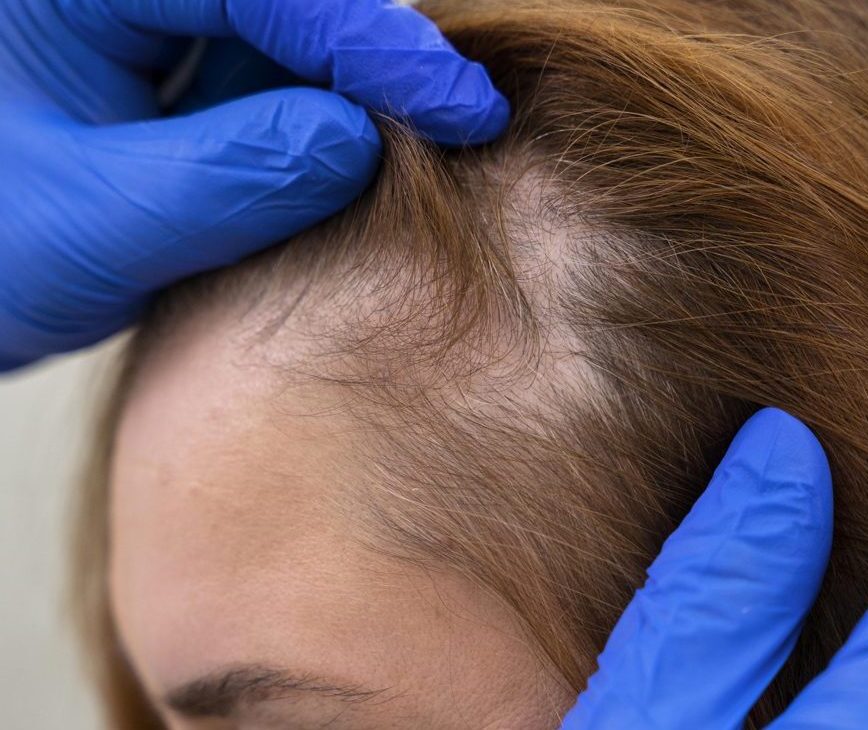
Female pattern baldness is a long-term hair loss condition in women which hair follicles gradually shrink, producing finer, shorter and lighter hairs. This process is called follicular miniaturisation.
Over time, the growth phase of the hair cycle shortens, and more hairs enter the resting phase. As a result, overall density decreases and the scalp becomes more visible.
Unlike male pattern baldness, women usually retain the frontal hairline and rarely develop smooth bald patches. Thinning most often affects the central parting and crown. Female pattern hair loss can begin at any age after puberty but becomes more common with increasing age, particularly after menopause.
Does female pattern baldness run in families?
Yes. Genetics play a significant role. A family history of hair thinning in either women or men increases the likelihood of developing female pattern hair loss. The condition is influenced by inherited sensitivity of hair follicles to androgen hormones.
Is female pattern baldness permanent?
Female pattern hair loss is usually progressive and long term. It cannot be cured, but treatment may slow progression and help maintain or modestly improve hair density. Early diagnosis improves the likelihood of stabilising hair loss.
Symptoms and Causes
What does female pattern hair loss look like?
Typical signs include:
- Gradual widening of the central parting
- Diffuse thinning over the crown
- Reduced overall hair volume
- Thinner ponytail
- Increased scalp visibility in bright light
Hair shedding may increase in some women, but many notice gradual thinning rather than dramatic hair loss.
Dermatologists often classify female pattern hair loss using the Ludwig scale, which describes mild, moderate and advanced thinning across the crown.
Does it affect the front of the head?
Many women search for “hair loss at the front of the head in females”, but in female pattern baldness the frontal hairline is usually preserved.
Thinning typically occurs behind the hairline, rather than causing true recession. If there is noticeable hairline recession or patchy loss, other conditions such as traction alopecia, frontal fibrosing alopecia, or telogen effluvium should be considered.
What causes female pattern baldness?
Female pattern hair loss develops from a combination of genetic susceptibility and hormonal influence.
Hair follicles become increasingly sensitive to androgens, including dihydrotestosterone (DHT). This sensitivity shortens the active growth phase (anagen) and leads to progressive miniaturisation.
Hormonal changes may influence onset or progression. Thinning often becomes more noticeable after menopause, when oestrogen levels decline. However, many affected women have normal hormone levels.
Does stress cause female pattern hair loss?
Stress does not directly cause female pattern baldness.
However, significant physical or emotional stress can trigger telogen effluvium, a temporary shedding condition. When telogen effluvium occurs alongside female pattern hair loss, thinning may appear more sudden or pronounced.
Diagnosis and Tests
How is female pattern baldness diagnosed?
Diagnosis is usually clinical and based on:
- Examination of hair density and distribution
- Review of medical and family history
- Assessment of progression over time
Dermatologists may use dermoscopy to examine hair shaft thickness and follicular changes.
Are tests ever needed?
Blood tests may be recommended if there are signs of other contributing conditions, such as:
- Iron deficiency
- Thyroid disease
- Hormonal imbalance
These tests help rule out other causes of hair loss that may require different management.
Management and Treatment
How is female pattern baldness treated?
Treatment aims to slow progression, maintain existing hair and improve density where possible. Results vary and treatment is usually ongoing.
Treatment options
Topical treatments
Oral and hormonal treatments
- In selected cases, a specialist may prescribe oral treatments that modify hormonal influence. These are not suitable for everyone and require medical supervision.
Hair restoration procedures
- In stable cases, hair transplantation for women’s hair loss may be considered. Suitability depends on pattern and donor hair availability.
Outlook/Prognosis
Female pattern hair loss usually progresses slowly over years.
With early and consistent treatment:
- Progression can often be stabilised
- Some improvement in density may occur
- Complete restoration is uncommon
The condition does not affect physical health but can significantly impact emotional wellbeing.
Emotional impact
Hair loss can affect confidence and quality of life. Support from healthcare professionals and appropriate treatment can help reduce psychological distress. Seeking help early may improve both physical and emotional outcomes.
Prevention
Can female pattern baldness be prevented?
Because genetic factors play a central role, female pattern baldness cannot always be prevented. Early recognition and treatment may help slow progression.
What self-care steps support hair health?
- Avoid excessive heat styling and tight hairstyles
- Maintain good general health and nutrition
- Seek medical advice if thinning develops or worsens
Lifestyle measures alone cannot stop female pattern hair loss, but they can support overall scalp and hair health alongside medical treatment.
When to seek medical advice
You should speak to a GP, dermatologist or hair specialist if you notice hair thinning that is:
- Progressive or worsening over time
- Sudden or rapid in onset
- Patchy, rather than diffuse thinning
- Associated with scalp symptoms, such as pain, redness, scaling or itching
- Occurring alongside other symptoms, such as irregular periods, excess facial or body hair, or unexplained weight changes
- Causing significant emotional distress or affecting quality of life
Medical assessment is also recommended if you are unsure about the cause of your hair loss or if over-the-counter treatments have not helped. Early evaluation can help confirm the diagnosis, rule out other causes and guide appropriate treatment.