






Caffeine is one of the most widely consumed stimulants in the world and is commonly found in coffee, tea, and energy drinks. Because hair loss is a widespread concern, many people wonder whether caffeine consumption could contribute to thinning hair or baldness.
Current scientific evidence indicates that caffeine itself does not cause hair loss. Most cases of progressive hair thinning are related to genetic and hormonal factors, particularly a condition known as androgenetic alopecia, or male and female pattern hair loss.
Interestingly, some research suggests that caffeine applied directly to the scalp may influence hair follicle activity. Laboratory studies have shown that caffeine may stimulate hair follicles and prolong the hair growth phase under certain conditions.

Understanding how caffeine interacts with hair follicles helps clarify whether caffeine plays a role in hair loss or hair growth.
Key Takeaways
- Caffeine consumption does not cause hair loss, and moderate coffee intake has not been linked to androgenetic alopecia.
- Topical caffeine may stimulate hair follicles and may counteract some hormone-related suppression of hair growth in laboratory studies.
- Drinking coffee does not significantly influence hair growth, as caffeine concentrations reaching hair follicles through the bloodstream are very low.
- Caffeine shampoos and topical products may support scalp health, but clinical evidence is still limited and they should not replace established hair loss treatments.
Does caffeine cause hair loss?
There is currently no scientific evidence showing that caffeine causes hair loss.
Most cases of progressive hair thinning are caused by androgenetic alopecia, a hereditary condition influenced by genetics and hormones. In this condition, hair follicles become sensitive to dihydrotestosterone (DHT), a hormone derived from testosterone.
Over time, DHT causes hair follicles to shrink through a process known as follicular miniaturisation. As follicles become smaller, they produce progressively thinner hair strands until hair growth eventually stops.
Scientific studies have not shown that caffeine increases DHT levels or accelerates this process. If you are experiencing hair thinning, it is far more likely to be related to:
- genetic predisposition
- hormonal changes
- stress or illness
- nutritional deficiencies
- certain medications
rather than caffeine consumption.
The relationship between caffeine and hair growth
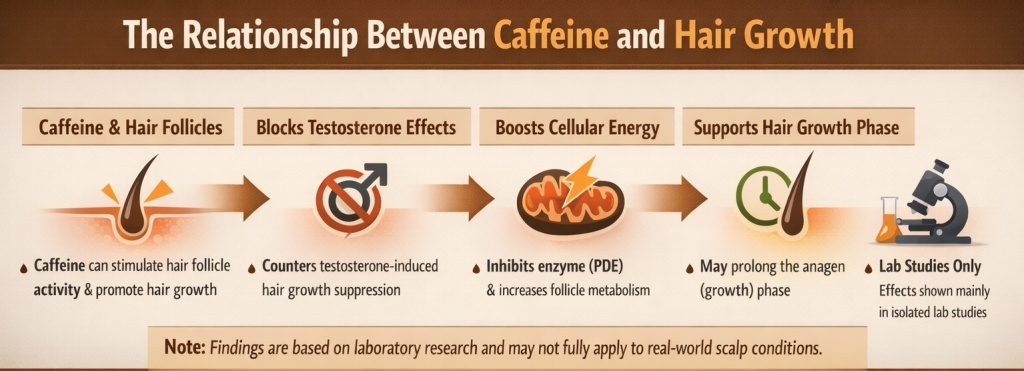
Although caffeine does not cause hair loss, some studies suggest it may have beneficial effects on hair follicles when applied directly to the scalp.
Laboratory research examining isolated human hair follicles has shown that caffeine can stimulate hair shaft elongation and promote hair follicle activity.
In one study, caffeine exposure counteracted testosterone-induced suppression of hair growth in cultured follicles and increased hair shaft production. (human hair follicle proliferation study)
Researchers believe this effect may occur because caffeine inhibits phosphodiesterase, an enzyme that influences cellular metabolism. By inhibiting this enzyme, caffeine may increase cellular activity and energy metabolism within hair follicles.
Some studies also suggest caffeine may support the anagen phase, which is the active growth phase of the hair cycle. However, it is important to note that most research has been conducted in laboratory conditions using isolated follicles, and results may not fully translate to real-world scalp conditions.
Can drinking coffee stimulate hair growth?
Although laboratory studies show that caffeine can stimulate hair follicles, drinking coffee is unlikely to significantly influence hair growth.
When caffeine is consumed orally, it enters the bloodstream and is distributed throughout the body. Only a very small amount reaches the scalp and hair follicles.
The concentrations used in laboratory studies are typically much higher than those achievable through normal dietary intake.
For this reason, drinking more coffee will not deliver enough caffeine to hair follicles to influence hair growth. Additionally, caffeine is metabolised relatively quickly by the body, meaning any potential biological effect would be short-lived.
While coffee consumption is unlikely to affect hair growth, it also does not appear to contribute to hair loss.
Caffeine shampoos and topical treatments
Interest in caffeine’s potential effect on hair follicles has led to the development of caffeine-infused shampoos, tonics, and scalp treatments.
Some studies suggest that caffeine can penetrate the scalp and reach hair follicles through the hair follicle pathway. Laboratory models have shown that topical caffeine exposure may:
- stimulate hair shaft elongation
- increase follicular cell metabolism
- support the hair growth phase
However, clinical evidence in humans remains limited and results vary between studies.
Several factors influence whether caffeine-based products may provide noticeable benefits.

Product concentration
The amount of caffeine in the formulation is important. Many cosmetic shampoos contain relatively small amounts that may not reach biologically active levels.
Contact time
Shampoos are often rinsed away quickly, which may reduce the time caffeine has to penetrate the scalp. Leave-in treatments may allow longer exposure.
Consistency of use
Any potential benefit is likely to require consistent application over several months, as hair growth cycles are slow.
While caffeine shampoos may help support scalp health, they are not considered primary treatments for significant hair loss.
Evidence-based treatments for hair loss
For individuals experiencing progressive hair loss, several treatments have stronger clinical evidence.
Minoxidil
Minoxidil is a topical medication that can stimulate hair follicles and prolong the growth phase of the hair cycle. It is widely used to treat androgenetic alopecia.
Finasteride
Finasteride is an oral medication that reduces DHT levels by inhibiting the enzyme 5-alpha reductase, which converts testosterone into DHT.
Hair Transplant Surgery
For individuals with advanced hair loss, surgical procedures such as follicular unit extraction (FUE) can restore hair by relocating healthy follicles from the donor area to thinning areas.
Because donor follicles are typically resistant to DHT, transplanted hair often continues to grow normally in its new location.
When to seek professional advice
Occasional hair shedding is part of the normal hair growth cycle. However, persistent thinning or visible changes in hair density may indicate an underlying condition.
A professional assessment can help determine whether hair loss is related to:
- androgenetic alopecia
- telogen effluvium
- hormonal changes
- nutritional deficiencies
- scalp conditions
Early diagnosis allows treatment to begin before hair follicles become permanently inactive.
Conclusion
Current research shows that caffeine does not cause hair loss. Most hair thinning occurs due to genetic and hormonal factors, particularly androgenetic alopecia.
Laboratory studies suggest that caffeine may stimulate hair follicles when applied topically, but drinking coffee does not provide enough caffeine to significantly influence hair growth.
Although caffeine-based hair products may offer supportive benefits, individuals experiencing persistent hair loss should consider evidence-based treatments and seek professional medical advice.
Additional FAQs about caffeine and hair loss
Does caffeine shampoo actually work for hair loss?
Caffeine shampoos are marketed as treatments for thinning hair, but current research has not demonstrated that they can stop or reverse androgenetic alopecia. Laboratory studies suggest caffeine may stimulate hair follicles, but clinical evidence showing long-term benefits in humans remains limited.
How long should caffeine shampoo stay on the scalp?
Most caffeine shampoos are designed to remain on the scalp for around two to three minutes before rinsing. This allows time for caffeine to be absorbed through hair follicles. However, even with this exposure time, there is limited evidence that caffeine shampoos significantly influence hair loss progression.
Can caffeine improve scalp circulation?
Some researchers suggest caffeine may stimulate blood circulation in the scalp and increase metabolic activity in hair follicles. Improved circulation may support follicle function, but this effect has mainly been observed in laboratory settings rather than large clinical trials.
4. Are caffeine hair products safe to use daily?
Most caffeine-based shampoos and scalp treatments are considered safe for regular use. Side effects are uncommon, although some people may experience mild scalp irritation or dryness if the product is used too frequently.
Can caffeine help reduce hair shedding?
Caffeine may support hair follicle activity in experimental studies, which has led to interest in its potential role in reducing hair shedding. However, current evidence does not show that caffeine alone can prevent shedding associated with genetic hair loss.
Does caffeine work better when combined with other hair loss treatments?
Caffeine products may sometimes be used alongside established treatments such as minoxidil or finasteride. In these cases, caffeine may act as a supportive ingredient rather than a primary treatment, as medical therapies remain more effective for androgenetic alopecia.
Can applying coffee directly to the scalp help hair growth?
Applying brewed coffee or coffee grounds directly to the scalp is unlikely to produce the same effects seen in laboratory studies. Most of the caffeine in coffee dissolves during brewing, and cosmetic formulations are specifically designed to deliver caffeine to hair follicles more effectively.
Does caffeine shampoo work for both men and women?
Caffeine-based hair products are often marketed to both men and women. While they may improve hair texture or thickness temporarily, there is no strong clinical evidence that they treat male or female pattern hair loss.
Can caffeine strengthen existing hair
Some caffeine hair products contain additional ingredients such as antioxidants, vitamins, or conditioning agents. These formulations may improve hair strength or thickness, which can make hair appear fuller even though they do not treat the underlying cause of hair loss.
Is caffeine a replacement for medical hair loss treatments?
No. Although caffeine may have mild stimulatory effects on hair follicles in laboratory studies, it is not considered a substitute for medically approved treatments such as minoxidil, finasteride, or hair transplantation when treating androgenetic alopecia.

If you are noticing hair thinning or increased shedding, a professional assessment can help identify the cause and discuss suitable treatment options.
- Medical Disclaimer:
This article is provided for educational and informational purposes only. The information presented reflects current medical research on caffeine and hair loss but should not be considered a substitute for professional medical advice, diagnosis, or treatment.


 CALL US
 WHATSAPP